Mining for sunshine

One doesn’t need to travel far on Highway 83 north of Bismarck to see a pair of these behemoths scooping overburden away from the two coal seams supplying Coal Creek Station. While I have crawled around this mine with my camera before, I don’t recall being on the draglines. I’ve climbed around on draglines at other mines, and it’s a blast, but these are even bigger yet!

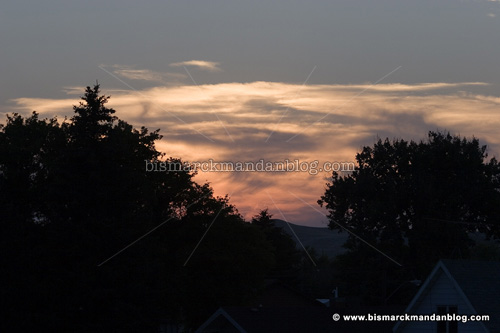
Photography is about being at the right place at the right time, and that’s how this photo came into being. The sun was just setting as I came up good ol’ 83 in my truck. I’d been eyeballing everything on either side of the road the entire time, looking for photo opportunities, and this one was not about to escape! I found an approach on which to park, sauntered over to the fence line, and here we are. I have a bunch of different angles and zooms, of course…but this one highlights the sun’s rays streaming from behind the clouds the best.
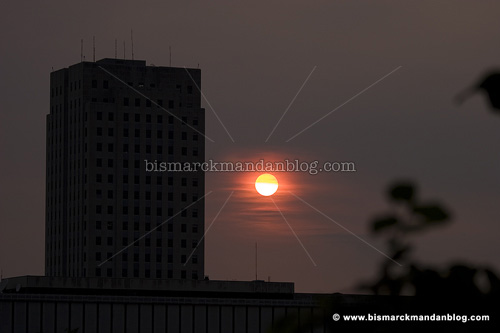
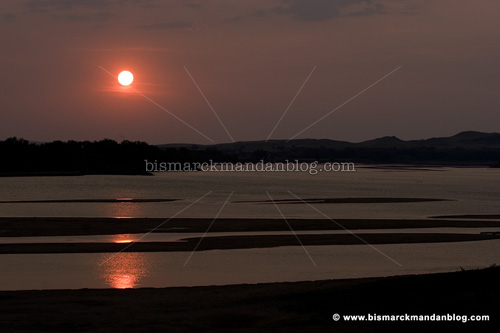
Chasing the red sun

I was out and about tonight, taking my wife and boy for a walk, when I noticed the red sun. I don’t know what was in the sky that it was so hazy, but the haze diffused the sun quite nicely. Once our evening was over and the family was home, I took off to see what kind of opportunities this might present photographically. The first shot of note was the one above, the capitol silhouetted against a red sky.

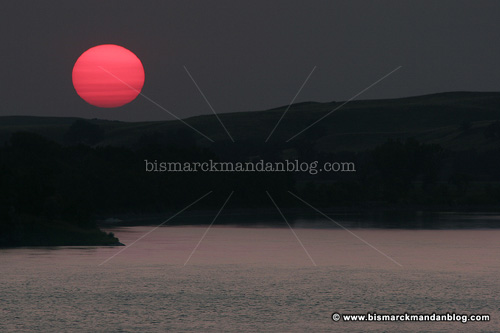
My next stop was the river, where I met a couple of fellow sunset chasers and get some shots of the dramatic red orb reflecting off the mighty Missouri. I just wish I’d had the time to hike down to the shoreline, but sadly that wasn’t the case. This was taken from atop the cliffs at Double Ditch.

Sadly, the same haze that gave the sun its color and definition also prevented anything amazing with the surrounding sky. I watched it reach the horizon and the reflections disappear from the river. I packed it in for the night. Relish these sunsets now, for the winter will bring hazy, dreary skies. It’s already the middle of July…the summer flies, doesn’t it?

Northern Lights Saturday

After we got done with the big show Saturday night (see the post below this one) my friend Mike and I headed back to his cabin along Lake Sakakawea. Along the way we saw some familiar lights in the sky. Yep, that’s right…after a long dry spell, I was finally going to get to take pictures of the Northern Lights! Here’s what we saw. I’m pretty sure the orange glow on the right is from Minot, as we were in a remote corner of Ward County.

I shot up another one of those notorious Minimum Maintenance roads that I’m known to favor. It seems that no matter where I am, even in a remote spot where I didn’t even know where I was, I can find those roads. They’re great for stomping on the brakes and taking pictures. Shortly after we took a couple of snapshots of the auroras and the Milky Way, the sky faded. That’s okay…we were fading too, after eleven hours of work. I pointed the truck back toward the lake, got a good night’s sleep, and made it back to Bismarck in time for church Sunday morning.

CF goes HD for the weekend

This weekend I got to work as a tapes and replay operator for a high-definition boxing broadcast. I was originally booked as a tape operator and, when the replay guy missed his flight from Seattle, I got to double up on replays too. During our lunch break Saturday I had a chance to poke around a little with my camera, so here’s a look behind the scenes.
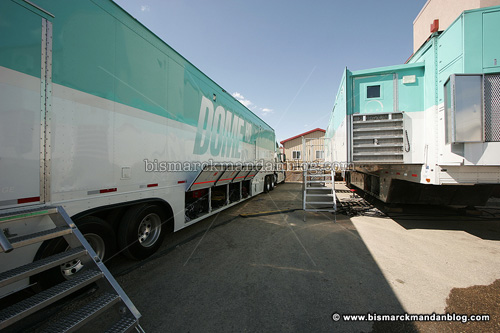
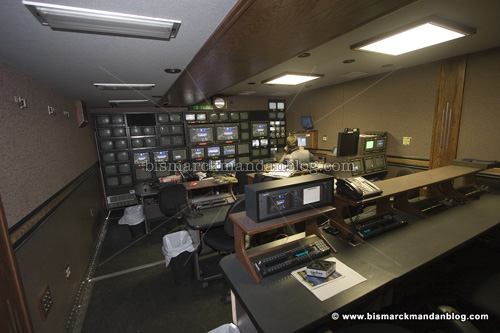
Here are the trucks they brought in for the job. I worked in the one on the right, the left is an engineering/utility truck. They roll it into place, slide out the sides, and assemble the control room areas before the crew arrives. Most of the guys flew in Friday, but I camped out at a friend’s cabin on the north shore of Lake Sakakawea that night. We got up Saturday morning, slowly got our morning off to a start, and rolled up to the truck at just after noon.

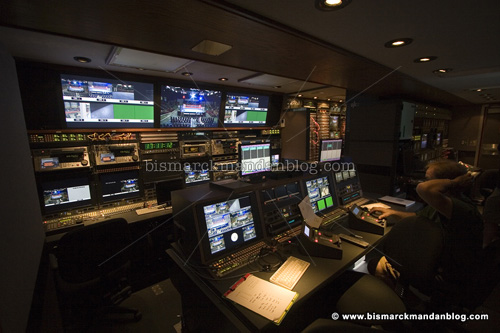
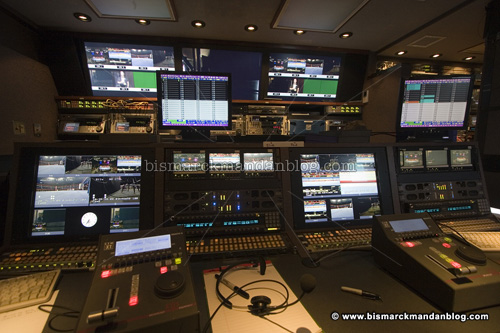
This is the front control room. Nothing on the monitors right now, as we were still getting everything set up. The technical director, the guy who actually switches between cameras and tape machines, inserting graphics and stuff as needed, sits up front. The director tells him which sources to take and when to put in graphics or replays. Behind him sit the graphics operator, producers, and assistants. On the other side of the wall of monitors is the audio room, and I forgot to poke my head in there.

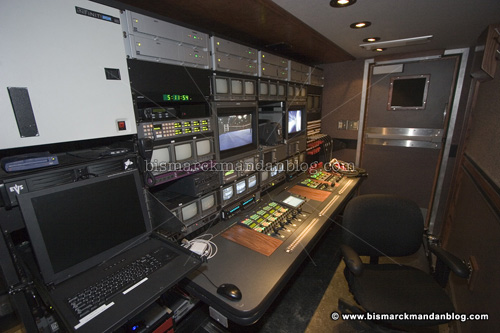
The next room back is where I worked, the tape room. I had a couple of 1080i HDCAM decks for high-definition broadcast, analog and digital standard-definition decks, and a couple of extra HD decks in case we needed them. The controls for the two replay units are on the counter to the right, where a friend of mine from Grand Forks is setting up the second unit.

The guy at this console “paints and shades” the cameras. The camera operators in the arena worry only about aiming their cameras and operating focus/zoom controls. As far as iris and color balance information, that’s where this guy comes in. He takes care of the fine tweaking on the fly so the camera operators can concentrate on getting their shots.

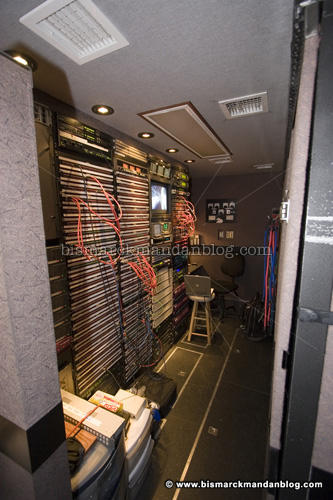
Engineering routing room. And you probably thought hooking up your stereo was complicated. The routing and communication systems are controlled by a laptop computer, as are the layouts and labels on all the flat panel monitors. For instance, in this show our tape decks were labeled with colors like Red, White, Green, and Blue instead of deck numbers. Electronic replay channels were A, B, X, and Y. On each monitor up front, the names of the camera and replay operators were also on the LED monitor labels.

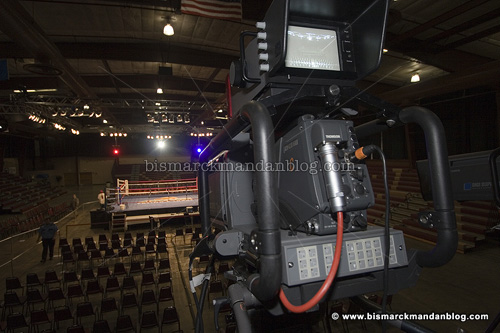
How about a couple hundred grand worth of camera? There were two of these in addition to the ringside and floor cameras. The circular glass elements of the 72x Canon HD lens on this camera is bigger than a dinner plate. Just lifting the lens onto the body takes two people, as the body of each piece is over a foot square. Once the beefy tripods are set up and the cameras are properly balanced, they pan and tilt very easily. My friend Mike was on one of these.

This was my view for the day. My EVS (commonly called “Elvis” ) controller and inputs are on this counter, with the decks up ahead on the wall. The left monitor is all my input/output sources with vectorscope and clock overlay. The middle is audio and video monitoring. The two monitors to the right are for the second Elvis. The monitor on top of the counter displays all my replay clips for each of the four input channels, where I can then call them up quickly and assign to either of two HD output channels. The controller allows me to jog back and forth, with a fader bar for replay speed.

I was hoping to have more pictures, but the fact that I got the additional duties and needed to self-train on the Elvis system kinda threw a a wrench into that plan. That’s okay, I’ve always wanted the opportunity to add Elvis Operator to my list of freelance credentials. Hopefully I’ll get the opportunity to do that again in the future, because it was a lot more exciting than just running tapes. I don’t know when or where these shows will be aired; the standard definition and high definition programs are going to be syndicated, to the best of my knowledge. It was a blast to be part of this crew, and I eagerly await my next freelance call!
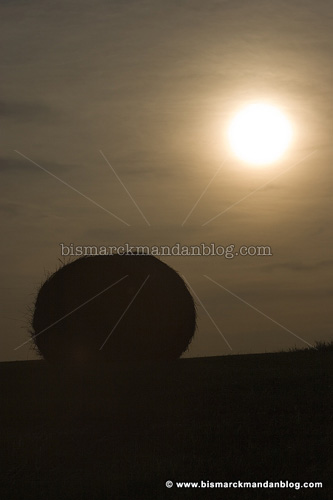
Hey!

That’s the kind of humor I have at 6am, when I took this photo…or pretty much any time I’m on the road. The gag is to point at hay bales and exclaim, “Hay!” Then, when the gullible subject has looked and asked what you mean, you simply point out the hay. It doesn’t always work with farm kids, as they know the difference between hay and straw.

The bad thing about these round bales: the cows can’t get a square meal out of ’em! Have a good weekend.

An exercise in shutter speed

I’ve said it repeatedly on this blog: I’m a novice when it comes to photography. I’m trying to learn, however, and that’s half the fun. There are a few things I’ve learned since the day I marched into Bob’s Photo and threw down for my trusty Canon digital camera:

1- Photography is all about the moment. Capturing a photo of something boring with technical perfection and artistic genius produces a perfectly boring photo.

2- As soon as you have more than one lens in your arsenal, you almost always have the wrong one on the camera at any given moment!

3- The only way to get a nice portfolio of decent pictures is to sink a pantload of time into chasing them.

There are others, but those simple truths should be sufficient for now. But let’s talk about another lesson: shutter speed. I decided to try for some different effects on this windmill, located in a field east of Bismarck:

It’s a nice windmill, sure; most of the time the wind has it pointed so there’s nothing but an ugly industrial park in the background. A few days ago I was lucky. I spotted it turned the right way, there was a blue sky, and the blades were moving too! That is when I decided to play with shutter speed.

By slowing things down a little bit, I’m able to start getting some blur in the blades. This conveys motion to the viewer. But by doing so I make my camera more sensitive to light, and have to crank the aperture (f-stop) down a little. This is at 1/160th of a second, aperture at f/5.6.

For a little more blur, I slowed things down to 1/30th of a second. The effect is great, and I had to adjust my aperture to f/11 in order to get that bright blue sky under control.

Here’s where things get interesting. I slowed way down to 1/8th of a second and got some really cool blur. Obviously I’m using a tripod, since it’s hard to keep steady for 1/8th of a second…even with an image stabilized lens. By now I’m cranking the aperture down to f/22.

By watching the meter in my viewfinder and adjusting accordingly, I was able to keep these photos consistent for exposure and color, only affecting the way the motion of the blades was captured.

One pitfall of a narrow aperture (high f-stop number) with a digital SLR camera is that it begins to reveal the inevitable dust on the camera’s sensor. I had to do a fair bit of spot removal to the last two photos as a result. Dust casts shadows on the sensor, but when the aperture is open wider, light gets around the dust. When the aperture starts to limit the light, the shadows get bigger and are seen by the sensor. That’s where Photoshop and a cleaning kit come in handy!

I hope you enjoyed this exercise. If you have any sort of camera that allows you manual control, and have a decent tripod, I encourage you to play around with this sort of thing. Learning photography is fun, and Bismarck-Mandan is full of interesting subject matter with which to expand your skills!

Well…

The sky was particularly dramatic on Tuesday night. I, despite getting out of the house a little late, was sliding my truck around the corners of some of my favorite gravel roads…chasing the sunset.

I stopped by my new favorite foreground object, this well. It stands in the middle of a wheat field, and I’m astonished that I ever even noticed it. I took some pics a while back in front of a solid red sky, but tonight there was a far more interesting backdrop.

After a while, the sun began to fade. That’s okay, there were still plenty of good photos to get. The departing sun was just getting started, as its rays began to blaze glowing linings around the clouds. All the action was starting to take place over the hills, though, so it was back into the truck to leadfoot my way northwest in search of higher ground.

Although I was on the Bismarck side of the river, and quite far away, my new telephoto lens was able to provide this shot of the wind farm at Center. By this time the sky was getting darker, the colors more saturated, and the sun’s rays were causing some really cool effects on the remaining clouds.

After that it was back home to my family. I got to thinking about that well, and how amazing it was that I discovered it. It reminded me of John chapter 4, where Jesus is talking with the Samaritan woman at the well. He said, “But whosoever drinketh of the water that I shall give him shall never thirst; but the water that I shall give him shall be in him a well of water springing up into everlasting life.” It’s true: only Jesus satisfies. I spent years –well, decades, really– feeling spiritual about my snowboarding, feeling spiritual about my motorcycling…people can feel a spiritual bond to anything they choose, but none of them will satisfy. In the book of Acts, Peter said, “Neither is there salvation in any other: for there is none other name under heaven given among men, whereby we must be saved.” I used to think that terms like “Born Again” and “saved” were part of a clever branding effort by evangelicals. Boy, was I shocked when I realized that Jesus declared that “Ye must be born again” !!!

It seems like a miracle that I discovered true Biblical salvation just like it seems miraculous that I could spot a lonely wellhead sticking out of a wheat field while sliding by at 60 miles per hour. Thankfully both miracles came to be. Now I have a far greater appreciation for the beauty of God’s creation, and especially for the part of it that falls within the parcel that we call North Dakota. Bismarck-Mandan…there’s no place I’d rather live!

Something old, something new…

While out on Saturday’s photo excursion, our travels took us past the wind farm at Regan. Among the wind generators, of which there are more every time I visit, we found this old school windmill. It seems like an anachronism among the high-tech towers, and makes for a great image.

I read in Prairie Business, a monthly regional magazine, that the only place in the USA which makes the blades for these things is in Grand Forks. LM Glasfiber is based in the Netherlands with their American facility here in North Dakota.

AC electric line current, by the way, works on a set frequency. Anything that generates power, whether it be a power plant, wind turbine, or hydroelectric generator, needs to be operating on the same frequency as the power grid. It also needs to be “in sync” with the oscillation of the power grid in order to be connected. If things get out of sync, the grid shuts down to protect itself. So how do you take a farm of 30+ wind turbines and synchronize them to the grid?

On many of the wind turbines you might see around North Dakota, the blade tips pivot to act as a speed brake of sorts. I believe the rotor pitch is also variable, so that the turbine spins at just the right speed to synchronize with the desired frequency. That’s a pretty low-tech way to do it, and requires a lot of mechanical measures to pull it off, so there’s another way…one I think is pretty innovative.

Instead of generating power and pumping it to the grid, while synchronizing to the grid mechanically, some turbines generate DC current and convert it to AC current before putting it into the line. They’re able to synchronize the power they generate electronically, without having to worry about moving parts and mechanical pitfalls. I’m told that the company which came up with this idea is a familiar one: the horrible Enron.

I’m just a layman, but that’s my primitive understanding of wind power in a nutshell. Feel free to correct me or clarify my explanation if you’re more knowledgable about such things. In the mean time, please enjoy the photo!

Headlights pointed at the dawn

A little Smashing Pumpkins lyric reference for y’all there. The song “1979” is a dreamy little tune that’s been on my mind lately, and 1979 is the year that I first returned to North Dakota. Today a few photography buddies and I piled into a vehicle and pointed our headlights at the dawn for real, exploring some of the Prairie Pothole Region northeast of Bismarck-Mandan. The photo above is a wide shot of the sky that greeted us.

We stopped many times and took photos of many different objects, but I’ll stick with this stop for now. The rest will be in future posts. This windmill happened to be in the right place at the right time to enjoy a blazing sunrise, and we were able to capture the moment from a dirt road adjacent to the land upon which it stood. Four guys, all with Canon gear but a variety of lenses, each digitized the scene through their eyes.

In a closer look at the top of this windmill, you can see that we weren’t the only ones appreciating it on this bright and early morning. The early birds, perhaps already done getting the proverbial worm, were present as well. On the wide open prairie there are few places to perch, so this was likely a frequent haunt for local feathered friends.

The crew on this trip include my friend Mike, the walking Encyclopedia Photographica, who’s on the mend from major back surgery. You can’t keep a good man down, and he’s the glue that holds this ragtag bunch together. He and I were able to dash down some gravel roads on Tuesday night in my truck, and hopped out a couple of times for some photos. It was the first time he’d walked uneven ground since his surgery, and it marks the new beginning of some awesome pictures! It’ll also mark the resumption of my photographic education. After all, I’m just a newbie at this…and learning is half the fun!